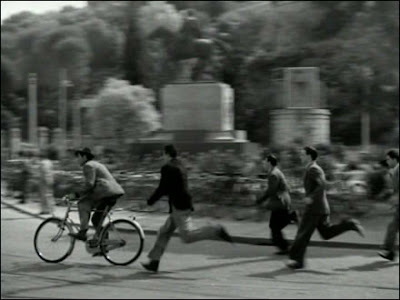
The Bicycle Thief is a gem attributed to the Italian Neo-realist movement. The film shows the creative bankruptcy of today's filmmakers. The film is slender and poetic. It tells a story that has universal appeal and is sure to touch hearts of all who have suffered misfortune and misery in a treacherous world, even once in their lifetime. By the measure of that metric only, the film is applicable to all. The beauty of the film lies in the simplicity of its screenplay. It shows how simplicity can achieve greatness, save the obfuscations of most modern day crap. The screenplay is not charmingly witty, not philosophically deep, not characteristically complex, not contemplatively silent. It is intensely emotional (without overdoing it) and fiercely personal. The story is rather simple: in post-World War Two Rome, Italy, jobs are scarce, and Antonio Ricci finally gets a job offer, as a billboard sign man, posting billboards about town, after waiting for months in front of the downtown labor office. One catch, he needs a bicycle. He has one, but it’s at a pawnshop. His wife, Maria, sells their good bedsheets so Antonio can get back his bike. The job is apparently a good one, as other workers anxiously vie for the job. Antonio suddenly feels human and dignified again, wearing a uniform, and being able to make money. Yet, on his first day at work, while pasting posters, his bike is stolen by a young man. Antonio has the weekend to get the bicycle back, so he can report to work on Monday with it. He gets his acquaintance, Baiocco, a garbageman, to help him look for the bike the next morning, along with some of his pals in the garbage company. But it is to no avail, so they keep on searching, and Antonio and Bruno have a number of encounters, such as seeing the thief with an old man, whom they track down to a church, but the old con man gives Antonio the slip, by saying he wants some of the free soup the church is offering. They do get a tentative address of the thief, and eventually Antonio catches up with him, and forces him back to his apartment, where his mother and neighbors declare him a good boy, an innocent. The vile wolfpack mentality closes in, and the thief plays his false innocence to the hilt, like the true professional grifter he is- likely having sold the bike already to another pawnshop, as a policeman is powerless to do anything, after they search the thief’s apartment. Antonio and Bruno eventually end up outside a soccer match, where hundreds of bikes are parked. He sees one in an alleyway, and, in a scene that shows a human desperation and honesty that are too often overlooked in art, Antonio gives Bruno some money to take a trolley home, and decides to steal the bike in the alley. Of course, he almost falls as he tries to pedal away, and the bike’s owner raises alarums, and this man’s neighbors chase and quickly capture Antonio- who is now pilloried as a bicycle thief, and a low man. He is so ashamed and without that he cannot even say a word. He is totally humiliated- all his honesty, honor, and playing by the rules have forced him into doing something wrong, and Bruno, who stayed behind, witnesses his father’s capture, runs to him, and weeps. The old man, whose bike it was, decides not to press charges, possibly out of pity for Antonio’s humiliation in front of his son, and Antonio walks away with his son, both weeping, yet hand in hand, having been defeated inside and out. Reputedly, none of the film’s actors were professionals, at the time. Antonio comes across so realistically, and wholly believably. Bruno is magnificent. He is wisecracking, but not in the annoying way Hollywood smart aleck kids are. There are numerous scenes that pinpoint the director's keen eye for details and highlight his tendency to maintain a desired balance between personal loss and humor, which relieves the viewer. Many critics have concluded that in The Bicycle Thief De Sica has tried to show that good and evil are relative. But nothing can be farthest from the truth. For instance, we know, all along, that the young professional thief would likely be a con man regardless as all of his neighbors are cheats and liars, and even his mother lies for her clearly guilty son. De Sica wants us to remind that sometimes evil can be born not out of pure evil, greed, and compulsive characteristic flaws, but can be born of different circumstances like desperation and poverty, as with Antonio. The Bicycle Thief is great art. It is not a political manifesto as many critics have vehemently suggested.The Bicycle Thief tells a simple tale, but it documents the crushing of the human spirit at the hands of poverty, indifference and misery.
The story of Brokeback Mountain a familiar one. Ennis Del Mar and Jack Twist are two cowboys who are hired by Joe Aguirre to shepherd sheep up on a Wyoming mountain named Brokeback. After a half hour of lushly scenery, Jack takes Ennis seduces Ennis and within seconds, Ennis is inexplicably battering Jack. Inexplicably because, a few scenes earlier, Jack was cooking and Ennis stripped naked to bathe, and neither man takes mind of what the other is doing. This gives an impression of instant gays, which is utterly absurd. In one of the reuniting scenes later, they practically bite off each other’s lips, indicating the extent of passion. Is this real? In the film, neither actor emits chemistry with nor eros for the other. Decades go by, and these two men marry, use, and abuse the women in their lives. Ennis is the worse of the two, for his wife Alma actually seems to love him, while Jack’s wife, Lureen, a former cowgirl, accepts the fact that he’s queer, and is romantically involved with Ennis in Wyoming. The wives are mere plot points in the film, not worth developing, especially since the leads are left in emotional utero even longer. The two male leads, however, look ridiculous in their poor makeup jobs. Aging, for them, consists of growing sideburns, it seems. Eventually, Ennis divorces his wife and Jack goes ‘full on’ in his quest for sexual quest, which eventually gets him to death at the age of thirty-nine. The best scene in the film is when Ennis calls Jack’s wife, after a postcard comes back marked deceased. Gyllenhaal is ok as Jack, but Heath Ledger totally butchers ‘cowboy’ lingo, constantly letting his Aussie accent seep through his near constant mumbling. On a social level, I am tired of films like this that indulges more gay stereotyping by making gay characters dying, murderous, depressed, deranged, victimized, or victimizer. And, ethically, the film does a lot of dancing around the ethics of adultery and lying in a marriage. For example, if this film were about two men who cheated on their wives with other women, would the film have portrayed their encounters so favorably? But, adultery is okay if gay, and letting your ‘true’ self be revealed. So, it’s ok to be a liar if queer, but if you lie and use women in your straight adultery it’s not ok? Brokeback Mountain is not a love story for the ages, but a tale of simple sexual obsession. This film simply subordinates whatever good artistic impulses the director may have had in favor of the Lowest Common Denominator import of the ‘message’. Were this a film whose leads were straight, the critics would have torn at it for being every bit as kitschy as the abominable Love Story was. Bad writing, and dubious moralizing, makes Brokeback Mountain every bit as bad a film as any other bad film.


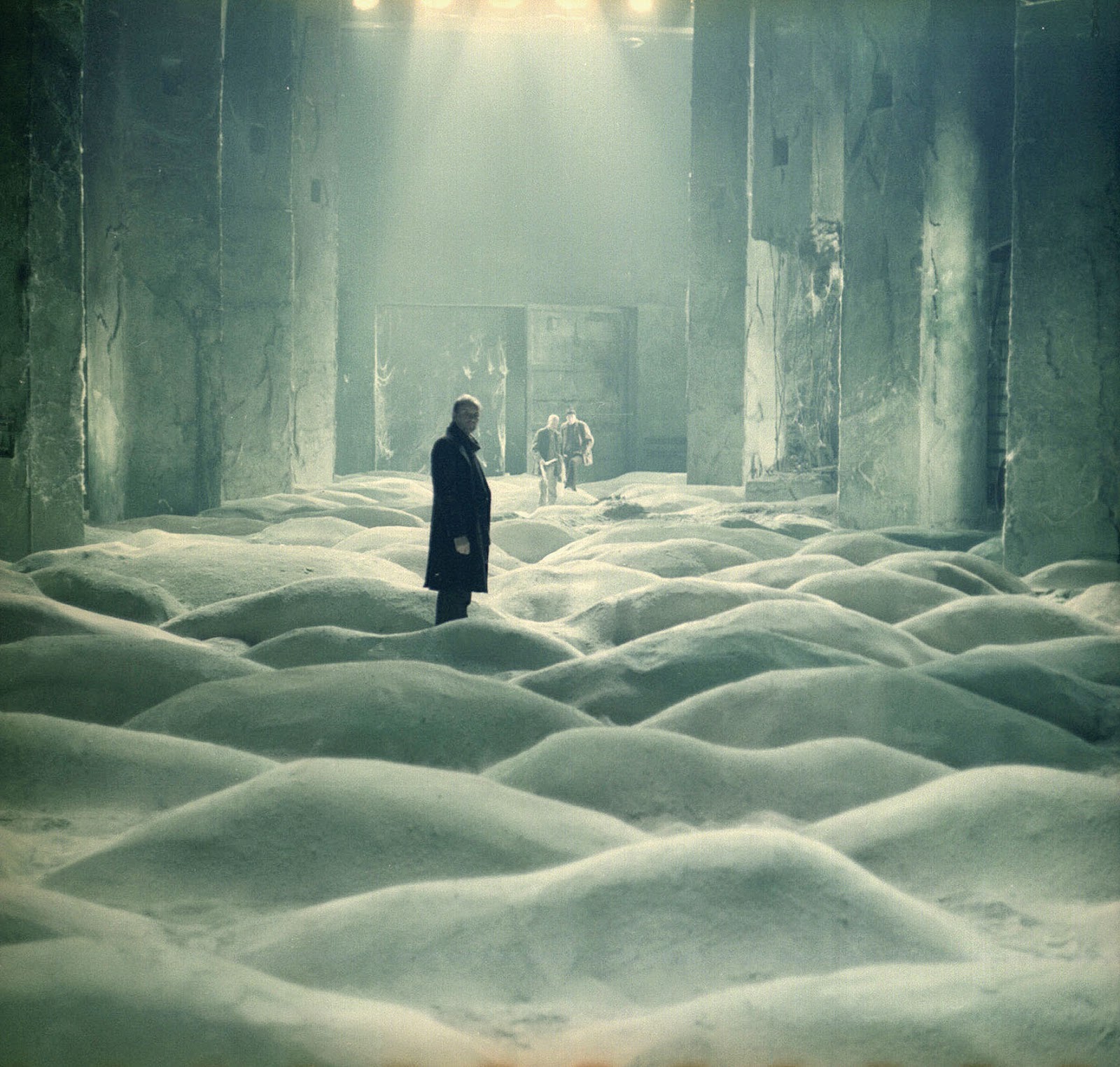
There are two outstanding moments that keep the The Sacrifice — Tarkovsky’s final film — upright and help explain what it is all about. It is quite beyond my capacity as a film analyst, at this moment, to describe this film of Tarkovsky, and nor can I suggest whether you’d like him or not. But I can at least say what he means to me. The film opens with a withdrawn shot of a father and son planting a barren tree in open farmland. The father is thinking aloud, blathering without direction; the boy is glum, diligent and mute. They secure a dwindled tree into the ground, and the father talks about the need to water it every day, before the scene moves on to esoteric subjects (for most of us) Nietszche, God, and haphazard cyclists. The scene lasts for around nine minutes and yet somehow its opening moment lasts for even longer. The image of a man brazenly planting a withered tree in the middle of nowhere — it’s Tarkovsky at his enigmatic best. The camera lingers and you notice the tree, the man, fields, a path, the sea, a hut; suddenly a multitude of material — be it massive or minute –unveils itself to your wandering eye. And you’re given the time to explore it. The camera doesn’t cut or move. It just shows, resolutely, knowingly.The Sacrifice is Tarkovsky’s sacrifice, and so are the rest of his films. Beautiful, obstinate and difficult. Tarkovsky’s films are all about the image — not the word or the narrative — and they frequently reveal the great amount of exertion behind their makeup. Each image is carefully cultivated to become an element unto itself — infinitely more variegated than a word, and more sacred than a sermon. At the end of The Sacrifice, the young boy sits beneath his now departed father’s tree and breaks his silence with damning effect; “In the beginning there was the word” he says. “Why is that, Papa?”.The effect is, I think, massively empowering. There’s space for the viewer’s imagination here, a suggestion almost anathema to the majority of films that reach our cinemas and televisions today.
The film centers on a woman (Eva played by Tilda Swinton) whose psychopathic son has pushed her to the edge of sanity. We Need to Talk About Kevin delves into Eva's mind by periodically moving between past and present. Eva lives with her husband, son and daughter in an expensive home in an idyllic small town. However, from the interiors of the house we could gather that the house has never become a home for its inhabitants. These people share a common physical structure, but their psychological structures are innately different from each other. Eva is skeptical of the marriage, doesn't want a child, and lacks instinctive kindness towards children. Her husband Farnklin (John C. Reilly) is an aloof man who appears situationally supportive of his wife, son, and daughter, cheerful,but lacks serious familial attachment and commanding position required of him as one of the parents. He is completely clueless about the alarming dynamics between his wife and son. Only the daughter, Celia, who is really young seems to be normal, but her normalcy is constantly shattered by Kevin, the son. Kevin is instinctively fiendish, who is supremely talented as to how to wound Eva, snub her, deceive her and make her soul bleed. Kevin seems to be living embodiment of the Devil. Kevin's character is depicted at three ages. As a baby, Kevin can try the patience of a saint. A relatively younger Kevin is such a little devil who enrages Eva so much that she breaks his arm. In the movie, this particular incident is seen more like a vicious triumph of Kevin than an instance of child abuse. As a teenager, Kevin is loving towards his father, but deliberately designs ploys to hurt Eva. The film starts with Eva dreaming about a lake of blood that ultimately turns into an annual tomato festival. Throughout the film the director uses the color Red as a route to emancipation for Eva while at the same time the same color is used to capture the disturbing psyche of Eva. Though the film is titled as We Need To Talk About Kevin, they never talk about Kevin. As if, by averting any dialogues and discussion about Kevin, the film emphasizes the need for such talks and on another level forces us to consider an important question that might plague the minds of the parents of troubled children: Is it nature or nurture? We Need to Talk About Kevin is a powerful film about a disturbed child and the magnitude of psychological trauma created in the minds of parents by a series of devilish acts by the child. The parents helplessly take the back seat like an audience and are ultimately nudged in the direction of psychosis.
The film was nominated for the Palme d’Or at the 2011 Cannes Film festival.