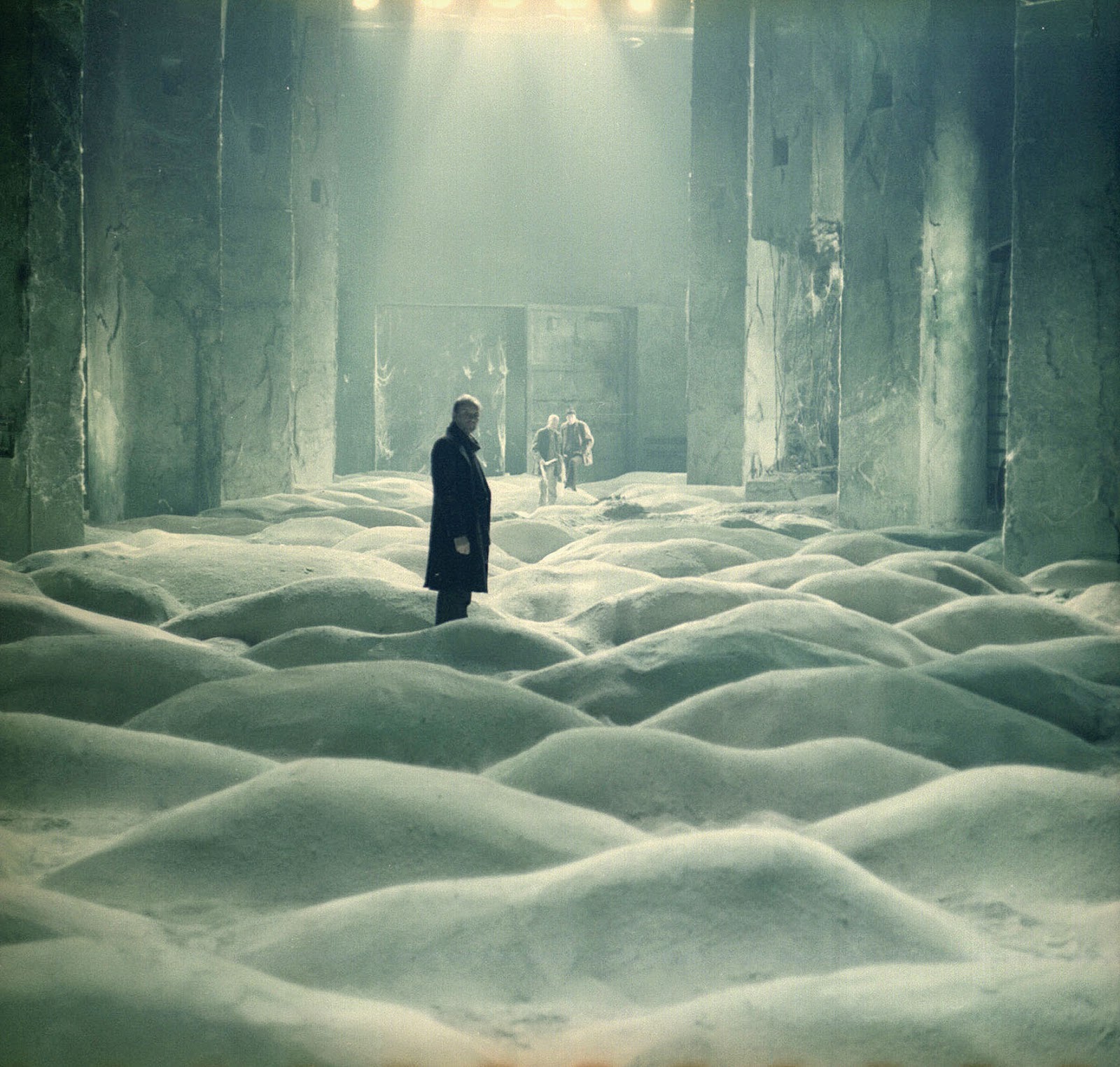
There are two outstanding moments that keep the The Sacrifice — Tarkovsky’s final film — upright and help explain what it is all about. It is quite beyond my capacity as a film analyst, at this moment, to describe this film of Tarkovsky, and nor can I suggest whether you’d like him or not. But I can at least say what he means to me. The film opens with a withdrawn shot of a father and son planting a barren tree in open farmland. The father is thinking aloud, blathering without direction; the boy is glum, diligent and mute. They secure a dwindled tree into the ground, and the father talks about the need to water it every day, before the scene moves on to esoteric subjects (for most of us) Nietszche, God, and haphazard cyclists. The scene lasts for around nine minutes and yet somehow its opening moment lasts for even longer. The image of a man brazenly planting a withered tree in the middle of nowhere — it’s Tarkovsky at his enigmatic best. The camera lingers and you notice the tree, the man, fields, a path, the sea, a hut; suddenly a multitude of material — be it massive or minute –unveils itself to your wandering eye. And you’re given the time to explore it. The camera doesn’t cut or move. It just shows, resolutely, knowingly.The Sacrifice is Tarkovsky’s sacrifice, and so are the rest of his films. Beautiful, obstinate and difficult. Tarkovsky’s films are all about the image — not the word or the narrative — and they frequently reveal the great amount of exertion behind their makeup. Each image is carefully cultivated to become an element unto itself — infinitely more variegated than a word, and more sacred than a sermon. At the end of The Sacrifice, the young boy sits beneath his now departed father’s tree and breaks his silence with damning effect; “In the beginning there was the word” he says. “Why is that, Papa?”.The effect is, I think, massively empowering. There’s space for the viewer’s imagination here, a suggestion almost anathema to the majority of films that reach our cinemas and televisions today.
The Mirror is a direct image of time created by a flux of thought-images (or thought-waves) propagating in the time-memory universe of Alexei’s mind. The film reflects the real life recollections and habitual memories of an existing person (Alexei as Tarkovsky’s persona) in relation to his family. It also mirrors the pure recollections associated with Alexei’s past, and especially, the involuntary recollections and virtual memories of his childhood dreams and fantasies. Mirror is a personal and self-revealing film with autobiographical characteristics that correlate private and collective memories. Over all, Mirror is a reflection of Tarkovsky's haunted soul: his search for spirituality, connection, Truth - exposed through indelible images that inevitably define our own imperfect lives, however trivial or mundane.


The Steamroller and the Violin is a short-feature film. The story in the film is very simple. The action takes place within one day, the dramatic composition is without sharp conflicts, and therefore non-traditional. Its main characters are a young worker driving a steamroller at a road construction and a young sensitive boy who is learning to play the violin. They become friends. Those two people, so different in every respect, complement and need one another. Music needs protection and resources to flourish whereas raw human effort longs for music as an ingredient for its emotional fulfillment. The intent of the director is to make a poetic film. The film is basing practically everything on mood, on atmosphere. The entire composition is filled with magnificent images. In Tarkovskiy's first film we already see the seeds of his later rejection of the mere symbol and his fundamental emphasis on the "creative efforts" of the audience. For example, note very carefully his deliberate use of the water element throughout the movie. Tarkovsky, at 28, was striving for his own Truth and his own Language, and The Steamroller and the Violin is very clearly the first baby-steps towards the full realisation of these concepts.